THE MAN WHO KNEW INFINITY - "An equation for me has no meaning unless it expresses a thought of God."- RAMANUJAM

Srinivasa Ramanujan 22 December 1887 - 26 April 1920 was an Indian mathematician who lived during British raj. Though he had almost no formal training in pure mathematics, he made substantial contributions to mathematical analysis, number theory, infinite series and continued fractions.
Early Life
Ramanujan was born on 22 December 1887 into a Tamil Brahmin Iyengar family in Erode, Madras Presidency (now Tamil Nadu), at the residence of his maternal grandparents.[9] His father, K. Srinivasa Iyengar, worked as a clerk in a sari shop and hailed from Thanjavur district.[10] His mother, Komalatammal, was a housewife and also sang at a local temple.[11] They lived in a small traditional home on Sarangapani Sannidhi Street in the town of Kumbakonam.[12] The family home is now a museum. When Ramanujan was a year and a half old, his mother gave birth to a son, Sadagopan, who died less than three months later. In December 1889, Ramanujan contracted smallpox, but unlike the thousands in the Thanjavur district who died of the disease that year, he recovered.[13] He moved with his mother to her parents' house in Kanchipuram, near Madras (now Chennai). His mother gave birth to two more children, in 1891 and 1894, but both died in infancy.
In 1903, when he was 16, Ramanujan obtained from a friend a library copy of a A Synopsis of Elementary Results in Pure and Applied Mathematics, G. S. Carr's collection of 5,000 theorems.[22][23] Ramanujan reportedly studied the contents of the book in detail.[24] The book is generally acknowledged as a key element in awakening his genius.[24] The next year, Ramanujan independently developed and investigated the Bernoulli numbers and calculated the Euler–Mascheroni constant up to 15 decimal places.[25] His peers at the time commented that they "rarely understood him" and "stood in respectful awe" of him.[21]
Srinivasa Ramanujan 22 December 1887 - 26 April 1920 was an Indian mathematician who lived during British raj. Though he had almost no formal training in pure mathematics, he made substantial contributions to mathematical analysis, number theory, infinite series and continued fractions.
Early Life
Ramanujan was born on 22 December 1887 into a Tamil Brahmin Iyengar family in Erode, Madras Presidency (now Tamil Nadu), at the residence of his maternal grandparents.[9] His father, K. Srinivasa Iyengar, worked as a clerk in a sari shop and hailed from Thanjavur district.[10] His mother, Komalatammal, was a housewife and also sang at a local temple.[11] They lived in a small traditional home on Sarangapani Sannidhi Street in the town of Kumbakonam.[12] The family home is now a museum. When Ramanujan was a year and a half old, his mother gave birth to a son, Sadagopan, who died less than three months later. In December 1889, Ramanujan contracted smallpox, but unlike the thousands in the Thanjavur district who died of the disease that year, he recovered.[13] He moved with his mother to her parents' house in Kanchipuram, near Madras (now Chennai). His mother gave birth to two more children, in 1891 and 1894, but both died in infancy.
In 1903, when he was 16, Ramanujan obtained from a friend a library copy of a A Synopsis of Elementary Results in Pure and Applied Mathematics, G. S. Carr's collection of 5,000 theorems.[22][23] Ramanujan reportedly studied the contents of the book in detail.[24] The book is generally acknowledged as a key element in awakening his genius.[24] The next year, Ramanujan independently developed and investigated the Bernoulli numbers and calculated the Euler–Mascheroni constant up to 15 decimal places.[25] His peers at the time commented that they "rarely understood him" and "stood in respectful awe" of him.[21]
When he graduated from Town Higher Secondary School in 1904, Ramanujan was awarded the K. Ranganatha Rao prize for mathematics by the school's headmaster, Krishnaswami Iyer. Iyer introduced Ramanujan as an outstanding student who deserved scores higher than the maximum.[21] He received a scholarship to study at Government Arts College, Kumbakonam,[26][27] but was so intent on mathematics that he could not focus on any other subjects and failed most of them, losing his scholarship in the process.[28] In August 1905, Ramanujan ran away from home, heading towards Visakhapatnam, and stayed in Rajahmundry[29] for about a month.[30] He later enrolled at Pachaiyappa's College in Madras. There he passed in mathematics, choosing only to attempt questions that appealed to him and leaving the rest unanswered, but performed poorly in other subjects, such as English, physiology and Sanskrit.[31] Ramanujan failed his Fellow of Arts exam in December 1906 and again a year later. Without a FA degree, he left college and continued to pursue independent research in mathematics, living in extreme poverty and often on the brink of starvation.[32]
It was in 1910, after a meeting between the 23-year-old Ramanujan and the founder of the Indian Mathematical Society, V. Ramaswamy Aiyer, also known as Professor Ramaswami, that Ramanujan started to get recognition within the mathematics circles of Madras, subsequently leading to his inclusion as a researcher at the University of Madras.[33]
Attention towards mathematics
Ramanujan met deputy collector V. Ramaswamy Aiyer, who had recently founded the Indian Mathematical Society.[47] Wishing for a job at the revenue department where Aiyer worked, Ramanujan showed him his mathematics notebooks. As Aiyer later recalled:
Aiyer sent Ramanujan, with letters of introduction, to his mathematician friends in Madras.[47] Some of them looked at his work and gave him letters of introduction to R. Ramachandra Rao, the district collector for Nellore and the secretary of the Indian Mathematical Society.[49][50][51] Rao was impressed by Ramanujan's research but doubted that it was his own work. Ramanujan mentioned a correspondence he had with Professor Saldhana, a notable Bombay mathematician, in which Saldhana expressed a lack of understanding of his work but concluded that he was not a phony.[52] Ramanujan's friend C. V. Rajagopalachari tried to quell Rao's doubts about Ramanujan's academic integrity. Rao agreed to give him another chance, and listened as Ramanujan discussed elliptic integrals, hypergeometric series, and his theory of divergent series, which Rao said ultimately converted him to a belief in Ramanujan's brilliance.[52] When Rao asked him what he wanted, Ramanujan replied that he needed work and financial support. Rao consented and sent him to Madras. He continued his research, with Rao's financial aid taking care of his daily needs. With Aiyer's help, Ramanujan had his work published in the Journal of the Indian Mathematical Society.[53]
One of the first problems he posed in the journal was:

He waited for a solution to be offered in three issues, over six months, but failed to receive any. At the end, Ramanujan supplied the solution to the problem himself. On page 105 of his first notebook, he formulated an equation that could be used to solve the infinitely nested radicals problem.

Using this equation, the answer to the question posed in the Journal was simply 3, obtained by setting x = 2, n = 1, and a = 0
Mathematical achievements
In mathematics, there is a distinction between having an insight and having a proof. Ramanujan proposed an abundance of formulae that could be investigated later in depth. G. H. Hardy said that Ramanujan's discoveries are unusually rich and that there is often more to them than initially meets the eye. As a byproduct of his work, new directions of research were opened up. Examples of the most interesting of these formulae include the intriguing infinite series for π, one of which is given below:

This result is based on the negative fundamental discriminant d = −4 × 58 = −232 with class number h(d) = 2. 26390 = 5 × 7 × 13 × 58 and 16 × 9801 = 3962 and is related to the fact that

This might be compared to Heegner numbers, which have class number 1 and yield similar formulae.
Ramanujan's series for π converges extraordinarily rapidly (exponentially) and forms the basis of some of the fastest algorithms currently used to calculate π. Truncating the sum to the first term also gives the approximation 9801√24412 for π, which is correct to six decimal places. See also the more general Ramanujan–Sato series.
One of Ramanujan's remarkable capabilities was the rapid solution of problems. Once, a roommate of his, P. C. Mahalanobis, posed the following problem:
His intuition also led him to derive some previously unknown identities, such as

for all θ, where Γ(z) is the gamma function, and related to a special value of the Dedekind eta function. Expanding into series of powers and equating coefficients of θ0, θ4, and θ8 gives some deep identities for the hyperbolic secant.
In 1918 Hardy and Ramanujan studied the partition function P(n) extensively. They gave a non-convergent asymptotic series that permits exact computation of the number of partitions of an integer. Hans Rademacher, in 1937, was able to refine their formula to find an exact convergent series solution to this problem. Ramanujan and Hardy's work in this area gave rise to a powerful new method for finding asymptotic formulae called the circle method.[99]
In the last year of his life, Ramanujan discovered mock theta functions.[100] For many years these functions were a mystery, but they are now known to be the holomorphic parts of harmonic weak Maass forms.
Hardy–Ramanujan number 1729
The number 1729 is known as the Hardy–Ramanujan number after a famous visit by Hardy to see Ramanujan at a hospital. In Hardy's words:[105]
Immediately before this anecdote, Hardy quoted Littlewood as saying, "Every positive integer was one of [Ramanujan's] personal friends."[106]
The two different ways are
- 1729 = 13 + 123 = 93 + 103.
Taxicab number
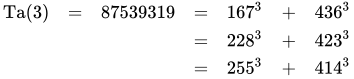
- In mathematics, the nth taxicab number, typically denoted Ta(n) or Taxicab(n), is defined as the smallest number that can be expressed as a sum of two positivealgebraic cubes in n distinct ways.
- Posthumous recognition
- Ramanujan's home state of Tamil Nadu celebrates 22 December (Ramanujan's birthday) as 'State IT Day'. A stamp picturing Ramanujan was released by the Government of India in 1962 – the 75th anniversary of Ramanujan's birth – commemorating his achievements in the field of number theory,[111] and a new design was issued on 26 December 2011, by the India Post.[112][113]Since Ramanujan's centennial year, his birthday, 22 December, has been annually celebrated as Ramanujan Day by the Government Arts College, Kumbakonam where he studied and at the IIT Madras in Chennai. A prize for young mathematicians from developing countries has been created in Ramanujan's name by the International Centre for Theoretical Physics (ICTP) in cooperation with the International Mathematical Union, which nominate members of the prize committee. The SASTRA University, based in the state of Tamil Nadu in South India, has instituted the SASTRA Ramanujan Prize of US$10,000 to be given annually to a mathematician not exceeding the age of 32 for outstanding contributions in an area of mathematics influenced by Ramanujan. Vasavi College of Engineering named its Department of Computer Science and Information Technology "Ramanujan Block".In 2011, on the 125th anniversary of his birth, the Indian Government declared that 22 December will be celebrated every year as National Mathematics Day.[114] Then Indian Prime Minister Manmohan Singh also declared that the year 2012 would be celebrated as the National Mathematics Year.
- Source : wikipedia



No comments:
Post a Comment